The AI Era – Birth of Your ‘Second Self’
AI persona setup, prompt fundamentals, building your personal AI partner. Deliverable: AI persona card + reusable core prompts.
Starts 3 Oct 2026 · 8th Cohort · On-site + Zoom simultaneous
We go beyond simply asking AI questions and uploading videos. Over 4 weeks you will build a practical system that connects AI personal media, a YouTube search page, homepage, SNS and QR application flow so people can search, discover and click.

View the main 8th-cohort brochure and additional materials. Check dates, learning goals, curriculum and application QR on both desktop and mobile.


Many participants reported that AI helped them apply learning to church ministry, mission, education, business promotion, personal branding and content creation. Building on that experience, this course strengthens YouTube search and click-traffic structure.
A search page is more than a list of videos. Like a library information desk, it organises videos by topic so visitors can quickly find and click the content they need — a true traffic gateway.
Greetings. The 8th cohort is hosted by invitation of Auckland Methodist Church. Around 200 missionaries, pastors, ministry workers, church members and general participants from New Zealand, Korea, Australia, the USA, Myanmar, Indonesia, Singapore and Africa have joined previous cohorts both on-site and via Zoom.
Gather videos, channels, playlists and descriptions in one place.
Classify content by topic, audience, problem and solution.
Let visitors find the videos they want via questions and keywords.
Improve titles, thumbnails, descriptions and next actions.
Connect homepage, SNS, QR and enquiry/application flows.
Starts from the basics so beginners can follow, yet every week produces usable content and platform results — a 70% hands-on course.
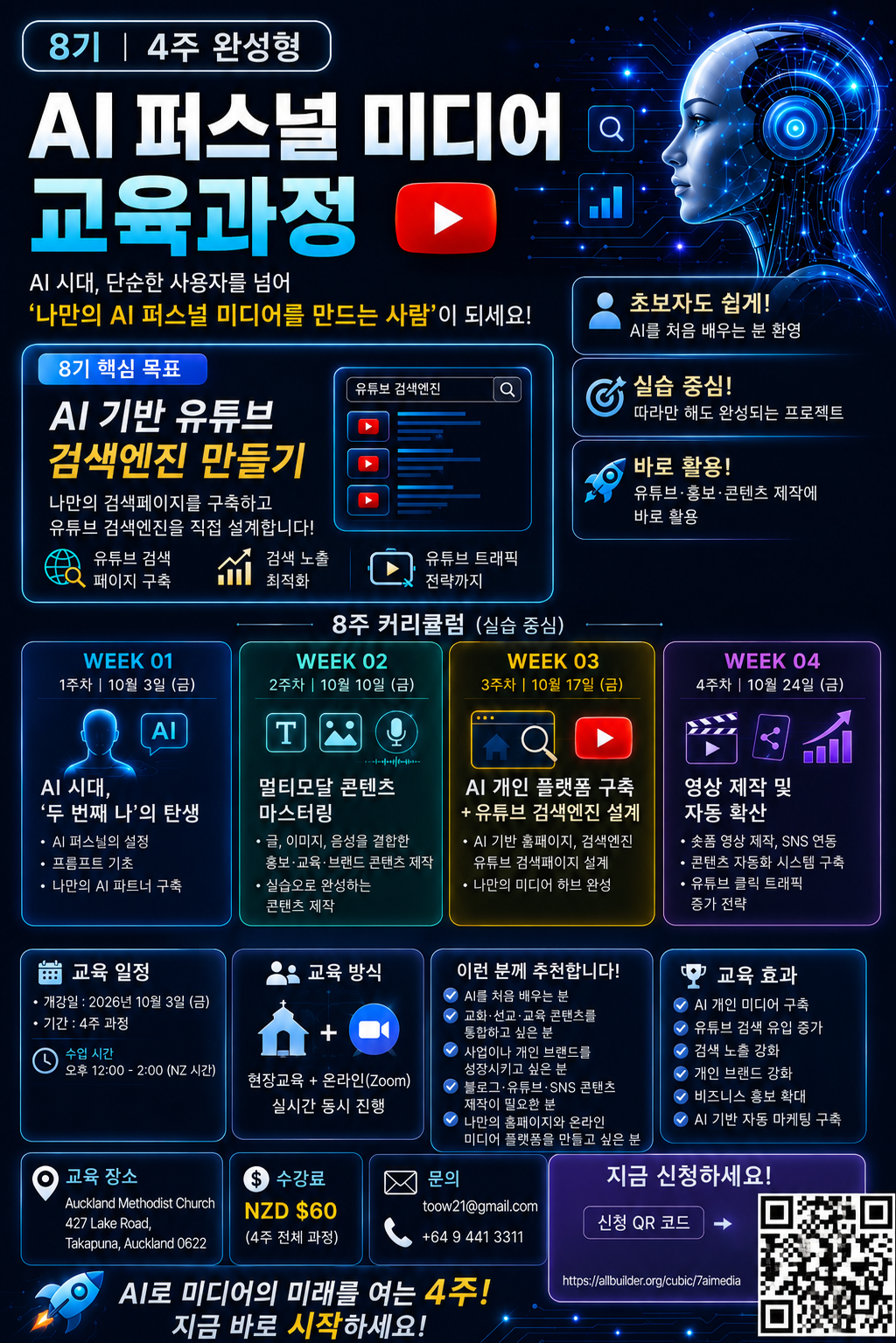
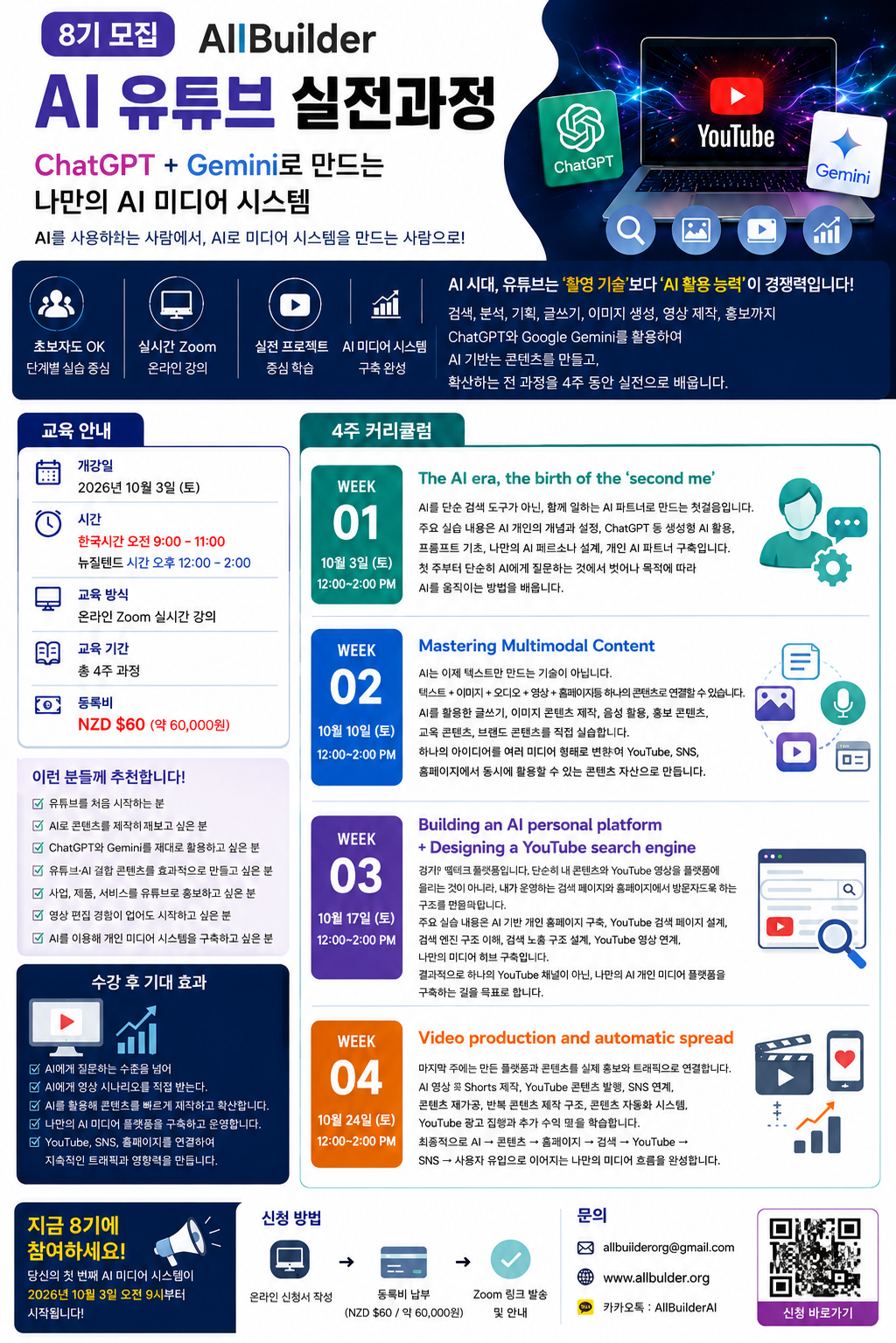
AI persona setup, prompt fundamentals, building your personal AI partner. Deliverable: AI persona card + reusable core prompts.
Create promotional, educational and brand content combining text, image and voice. Deliverable: 3 texts, 3 images, voice script for video.
Design AI-based homepage, search engine and YouTube search page. Complete your media hub. Deliverable: searchable video page + homepage draft.
Short-form video production, SNS integration, content automation system. Strategies to increase YouTube click traffic. Deliverable: video scripts, distribution plan, final personal media platform.
Instead of learning text, images, search, homepage, video and SNS separately, connect them into one personal media system.
Connect sermon summaries, teaching materials, mission videos and church homepage into a searchable media hub.
Connect products, services, customer reviews and YouTube videos to local search and enquiry forms.
Organise lecture materials, posters, blogs and YouTube videos into one personal platform.
Connect local hospitals, restaurants, buildings, events, people and services through video and semantic relationships into a living regional media search engine.
SmartCubic is not a simple collection of homepage links. It is an integrated regional media portal that connects places, industries, facilities, events, people, products, services and YouTube videos into one semantic network so content is repeatedly searched and rediscovered.
The same video can appear as different entry points for hospital search, food search, building search, event search or city search — because users have different questions and purposes.
Connects hospitals, oriental clinics, dental practices, pharmacies, clinicians, health-management videos and local health information.
Turns exhibitions, trade shows, seminars, education, performances, festivals and local events into video assets.
Makes restaurants, cafés, menus, cooking processes, customer reviews and local “best food” videos searchable.
Connects buildings, retail premises, shopping centres, offices, tenants, facilities and place information.
Integrates city-level living information and regional media such as All-in-Auckland, All-in-Seoul, All-in-LA and All-in-Sydney.
Connects industry, education and business specialist information (including All-That-Power) with regional content.
When an Auckland hospital uploads a health video, it can simultaneously appear in Health Cubic hospital search, All-in-Auckland local hospital search, Building Cubic medical facility info and MICE Cubic health seminars.
Church events, business seminars, health lectures, food festivals, performances, education, property briefings and community gatherings can remain searchable content long after the event ends.
These videos do not stay only on YouTube — they reconnect to MICE Cubic, regional portals, industry portals, Building Cubic, Food Cubic and Health Cubic.
Hospital, restaurant, shop, building, education, performance and seminar data are registered.
Introduction videos, interviews, educational videos, event footage and reviews are created.
Connected to Health, MICE, Food, Building Cubic and related specialist portals.
Appears on All-in-Auckland, All-in-Seoul, All-in-LA, All-in-Sydney and more.
Videos are discovered through city, industry, place, menu, event and service searches.
Searchers move to the YouTube channel, watch and subscribe.
Reviews, interviews, follow-up events and new information are created again.
New content links to existing information, making search results richer.
Traditional regional portals were closer to static homepages where an admin uploaded business listings. In SmartCubic, residents, hospitals, restaurants, buildings, event organisers, specialists and educational institutions continuously produce video and information. New content is classified and linked to relevant regions and specialist fields.
Even a single restaurant video can link country, city, suburb, building, restaurant, cuisine type, signature menu, opening hours, booking, event participation, YouTube channel, homepage, language and search keywords. A hospital video links region, medical specialty, clinicians, building, health events, consultation and booking.
SmartCubic is not a system that copies the same content into many places. It analyses the meaning and relationships of content and rebuilds the entry points that match each user’s search purpose. Health seekers see Health Cubic; event seekers see MICE Cubic; place seekers see Building Cubic; regional-info seekers see the city portal.
A good website is not one with lots of decoration — it is one that shows visitors the way so they never hesitate. Here are 10 principles applied in this course and website design, explained with simple analogies.
Templates only list visible sections. A studio site arranges problem → solution → proof → process → application in the order of the visitor’s questions. Corridors must be designed before rooms so no one gets lost.
Readable body (Noto Sans KR), strong numbers (Bebas Neue) and emotional emphasis (DM Serif Display) each have a role. Clear size and weight hierarchy matters more than using many fonts.
Empty space is not waste — it is the comma between sentences. Giving important content more breathing room makes it more visible, not less.
A slight lift on cards, changing button shadows and gentle fade-ins are enough. Motion should be a signpost, not fireworks.
Don’t stop at pretty photos. Show problem → decision → process → result → lessons. Why you did it builds more trust than what you did.
Check alignment, image ratios, button copy, link states and mobile spacing in order. The one thing to obsess over last: can the first-screen message and apply button be understood in 3 seconds?
Don’t treat a small screen as a shrunk PC. Design button height, type size and single-line inputs first so everything can be read and tapped with one hand.
Design keywords for search engines together with meaning structures for AI recommendation. SEO is writing the name on the sign; GEO is explaining where it is and who needs it.
Say the outcome (e.g. “Enquire about the course”) instead of “Learn more”. The form must actually submit via Formspree, not just change the screen.
Use larger type, high contrast, simple sentences, clear labels and alt text. Good accessibility is not a special feature — it is basic design that opens the door wider for every visitor.
The old way uploads a video and hopes. The new way systematically raises discoverability by connecting search, classification, thumbnails, homepage and SNS.
Drawing on 30+ years of IT, ERP, ESG, AI and digital-platform experience, he guides you step-by-step on applying AI to life, business, education, church and mission contexts.


He doesn’t stop at explaining what AI is — he teaches what you can build with it and how to apply it to life, business and ministry.
On-site classes in Auckland, New Zealand run simultaneously with live Zoom sessions. Please bring a laptop if attending in person.
We go beyond simply asking AI questions and uploading videos. Over 4 weeks you will build a practical system that connects AI personal media, a YouTube search page, homepage, SNS and QR application flow so people can search, discover and click.
You can enquire first via the Formspree form below or use the existing AllBuilder / All in Auckland / All in Seoul registration flow. Please re-confirm official details before payment.
Enter your name, email, organisation and questions in the Formspree form below. Existing AllBuilder members may use their existing account flow.
Enter basic details on AllBuilder, All in Auckland or All in Seoul and complete registration via the email confirmation link.
Payment available via BNZ (NZ), IBK (Korea), Commonwealth Bank (Australia) or PayPal/card. Please re-confirm official details before transferring.
After payment, send depositor name, receipt and contact email to receive Zoom link and preparation notes.
On-site participants bring a laptop; online participants check Zoom, email and YouTube accounts in advance.
Clear answers on whether you can join with no AI experience, what to prepare, and what deliverables you will leave with.
Start building your own YouTube search system that lets people search, discover, click and watch.
Enter a valid email address to receive registration details, preparation notes, Zoom instructions and follow-up guidance.
The 8th AI Personal Media course runs simultaneously at Auckland Methodist Church and on Zoom.
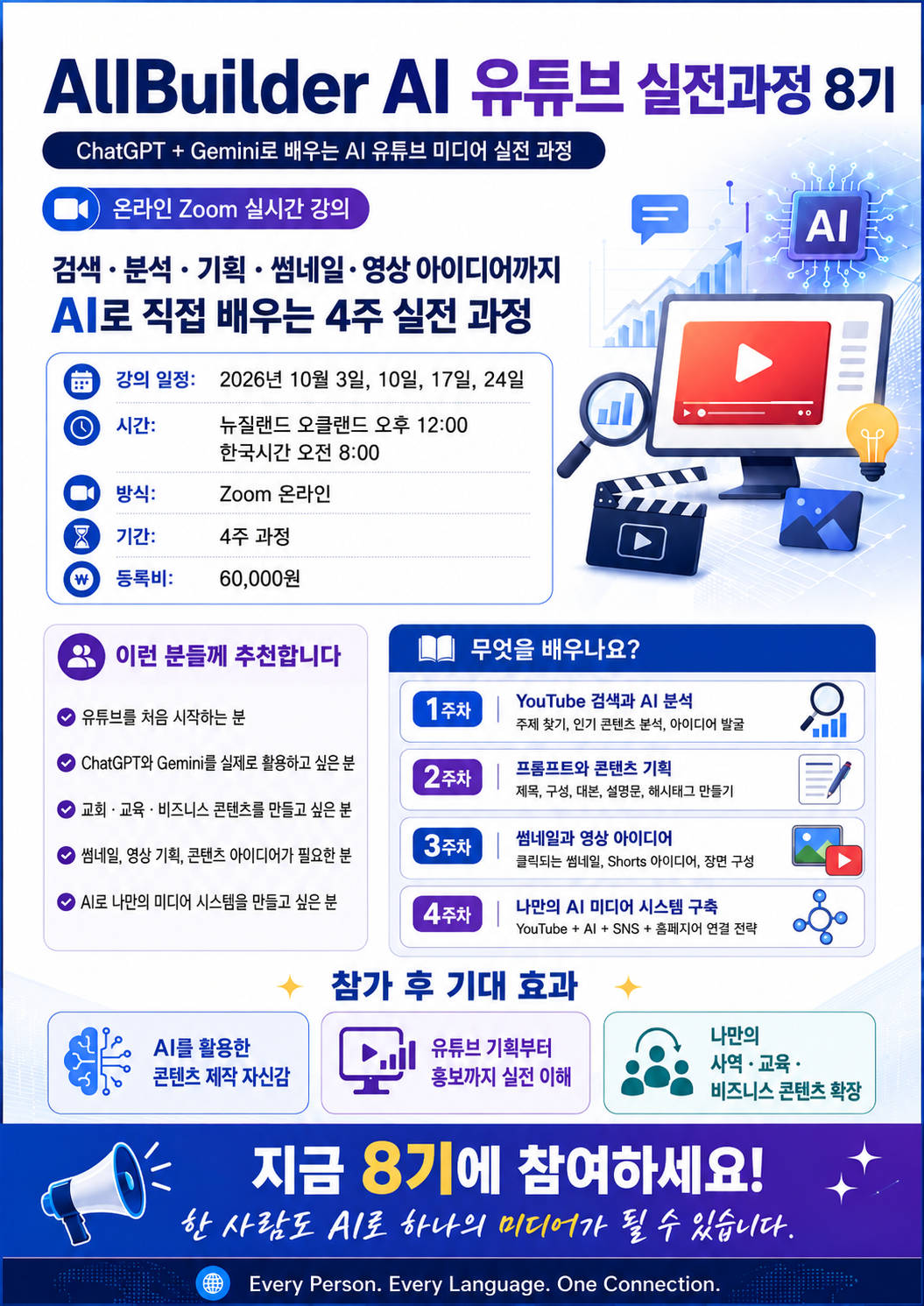
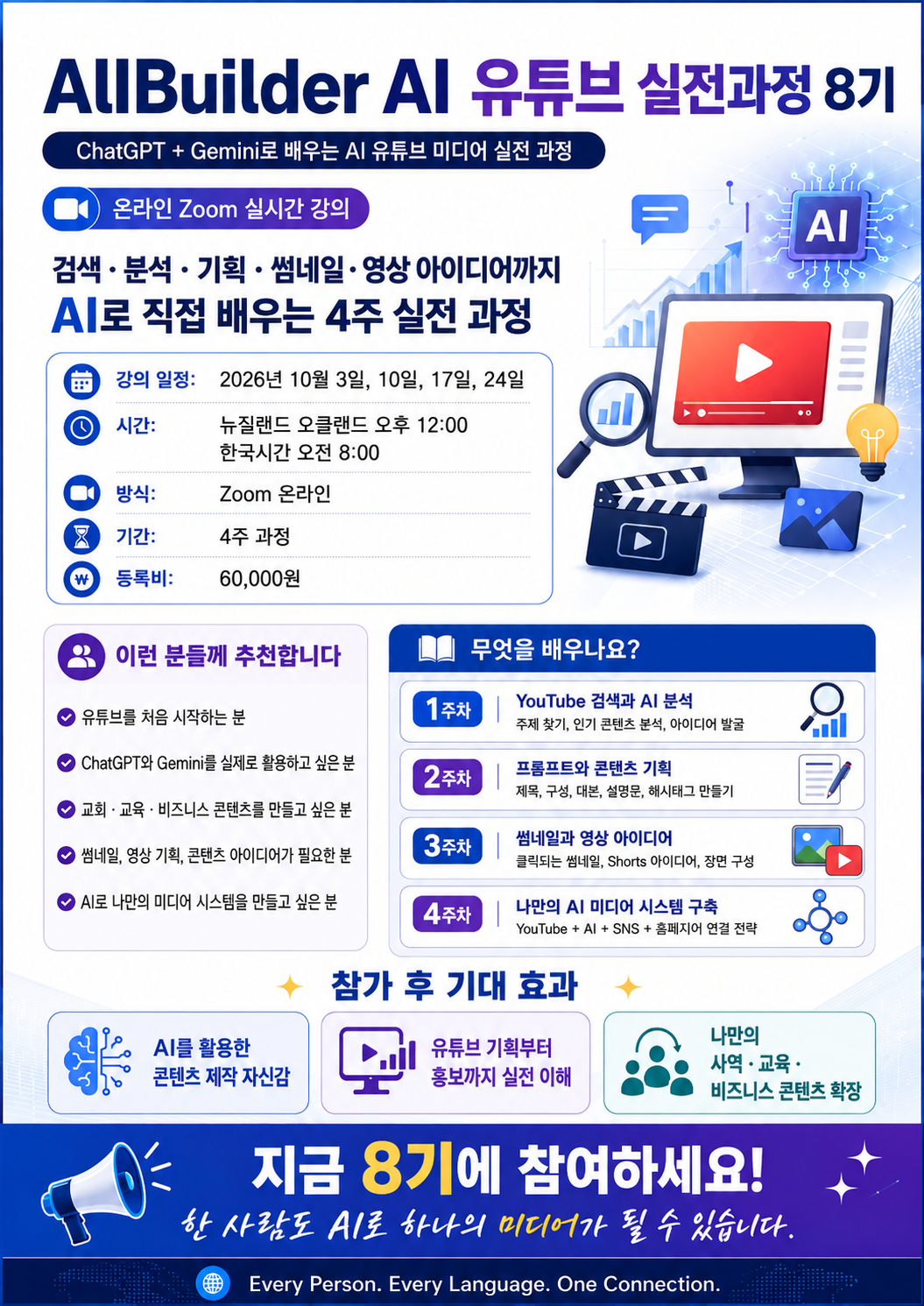
The 8th AI YouTube Course goes beyond learning AI as a search tool. Over four practical weeks, you will connect personal AI media, a YouTube search page, a website, social distribution and registration pathways into one system designed to help people search, discover and click your content.

Previous courses brought together around 200 missionaries, pastors, ministry workers, church members and general learners from multiple countries in person and on Zoom. The 8th cohort puts even more emphasis on search discovery and YouTube click-through flow.
The media and registration information are deliberately separated for clarity. Play both YouTube panels directly on the left and review the official 8th cohort brochure on the right.
A search page is more than a list of videos. Think of it as a library information desk that organises content by topic and purpose so visitors can find what they need and click faster.
The course starts at beginner level but leaves you with usable work every week, then connects the four outputs into one personal media system.
Personal AI concepts, ChatGPT, prompt basics, AI persona design and your own working AI partner.
Expand one idea into writing, images, audio, video and website content for YouTube, social media and promotion.
Build a personal AI website, a YouTube search page, a discovery structure and your own media hub.
Practice AI video and Shorts production, social connection, content repurposing and strategies for YouTube click traffic.
Instead of learning writing, images, search, websites, video and social media separately, connect them into one personal media system.
Connect sermon summaries, teaching resources, mission videos and church websites into a searchable media hub.
Connect products, services, reviews and YouTube videos to local search and enquiry pathways.
Organise teaching materials, posters, blogs and YouTube videos in one personal platform.
Connect hospitals, restaurants, buildings, events, people and services through video and meaning relationships to grow a living local media search engine.
Connect location, category, place, event and video as one relationship network
SmartCubic connects locations, industries, facilities, events, people, products, services and YouTube videos through a meaning-based network. One video can be discovered through different entrances such as health, food, buildings, events or city searches depending on the visitor's intent.
A health video can connect to Health Cubic, local hospital search, building information and health seminars. A restaurant video can connect to Food Cubic, city portals, shopping locations and food events, with viewing leading toward a website, enquiry, booking or visit.
Church events, business seminars, health talks, food festivals and education can leave a digital trail before, during and after the event, then remain discoverable through MICE Cubic and related city or specialist portals.
New local information produces videos, videos connect to specialist and city portals, visitors discover and act, and the resulting reviews and follow-up content make the search network richer again.
A premium website is not the one with the most decoration. It is the one that removes confusion and makes the important path obvious.
Arrange problem, solution, proof, process and application in the order visitors naturally ask questions.
Use a clear hierarchy of size and weight instead of adding many fonts.
Empty space is punctuation, not waste. Give important content room to be noticed.
Motion should behave like a signpost, not fireworks. Use subtle movement only when it helps orientation.
Show the problem, decisions, making process, result and lessons instead of only a gallery.
Check alignment, image ratios, button language, links and mobile spacing, then test whether the first screen is clear in three seconds.
Do not treat mobile as a smaller desktop. Design touch targets, text and forms for one-handed use first.
Use search keywords and meaning context so systems understand not only the name but where it fits and who needs it.
State the result of the action and make enquiry forms actually send data rather than behave like decoration.
Use readable text, strong contrast, simple sentences, clear labels and meaningful alternative text.
The old approach uploads and waits. The new approach connects search, classification, thumbnails, websites and social distribution to systematically improve the chance of discovery.
With more than 30 years of experience across IT, ERP, ESG, AI and digital platforms, Vincent guides learners through practical applications for life, business, education, church and mission.


AI · Semantic AI · Digital Platform Educator | Globaliz Founder & CEO
The focus is not only what AI is, but what you can build with it and how to apply it in work, business and ministry.
Auckland in-person training and live Zoom participation run simultaneously. In-person learners are encouraged to bring a laptop.
The course runs at the same time on four Saturdays.
Scan the QR code or use the online application button.
Use the official application page to register for the course. Use the enquiry form below for questions about content or preparation.
Enter your basic details on the official 8th cohort application page.
Use an accurate email address and phone number so course information can reach you.
Tuition is NZD $60. Follow the current official application instructions for payment details.
Online participants should check Zoom, email and YouTube access before class.
In-person participants are encouraged to bring a personal laptop for hands-on practice.
Connect each weekly output into a final personal media hub.
Enter an accurate email address for information about preparation, Zoom participation and follow-up. Use the official application page for the actual course registration.
The Auckland Methodist Church class and Zoom class run at the same time.
Send your question and we will follow up.
Simple answers about beginner access, preparation and what you will have at the end of the course.
Yes. The course starts with prompt basics and moves step by step through writing, images, search pages, video and social connections.
You build a personal search page that classifies your videos and related content around your purpose, then connect it to your website and social channels.
Yes. Auckland in-person teaching and live Zoom participation run simultaneously.
Reusable AI prompts, multimodal content, a searchable YouTube page, website structure, a video script and social distribution plan connected as one personal media hub.
Pastors, missionaries, ministry workers, educators, small businesses, YouTube operators, content creators and beginners building a personal brand.
The sessions are on 3, 10, 17 and 24 October 2026, Saturdays from 12:00-2:00 PM NZ Time. Full tuition is NZD $60.
8th AI YouTube Course · starts 3 October 2026 · four weeks · in-person + Zoom · NZD $60
Do more than upload a video and wait. In four practical weeks, connect AI content creation, a personal website, a YouTube search page, search discovery and social distribution into one beginner-friendly media system you can keep using.
Four Saturdays, one consistent time, and one connected AI personal media project.
Critical details are provided as readable HTML, not only inside images, and the YouTube video is embedded so visitors can watch it without leaving the page.
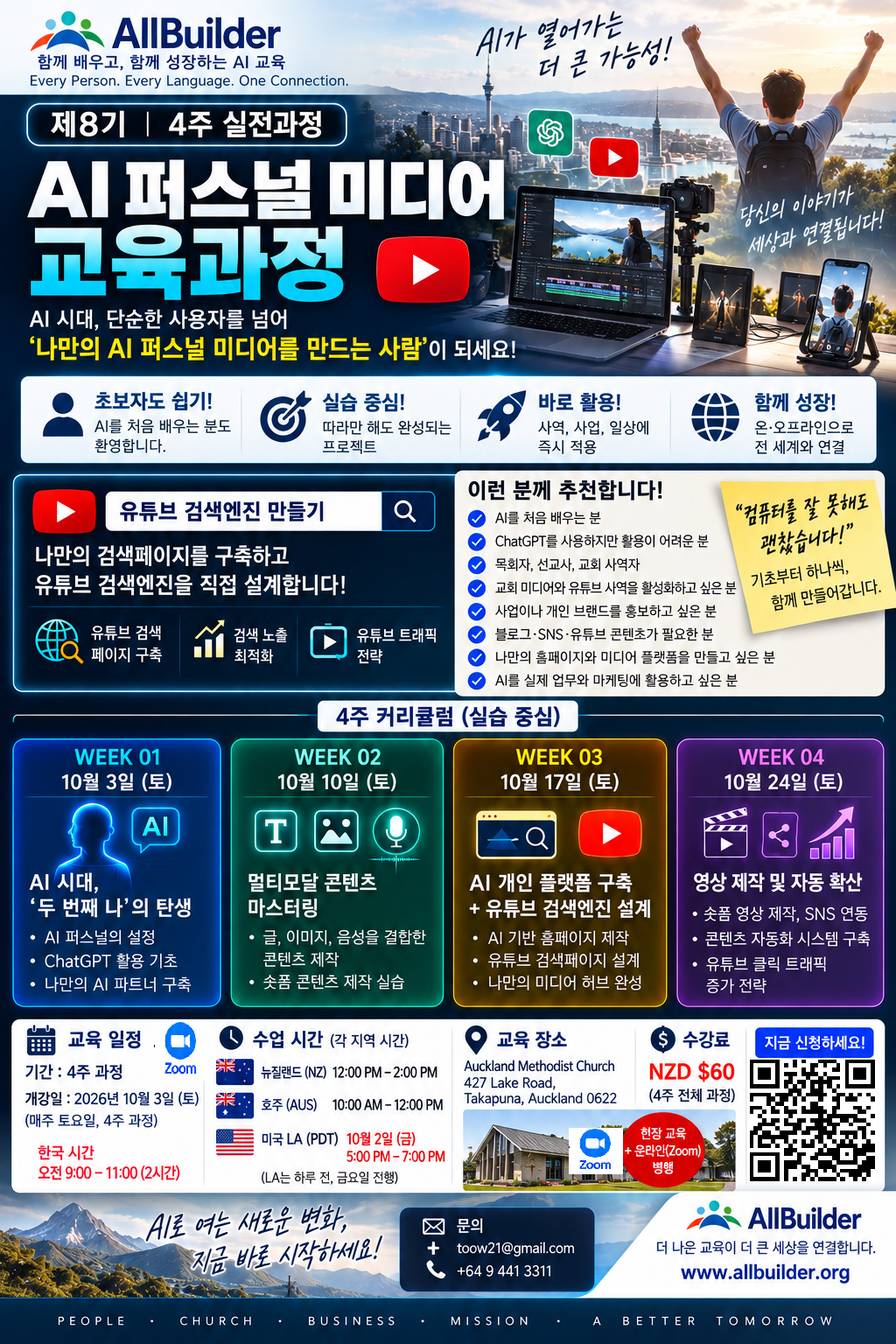
The brochure gives a fast visual overview of dates and the QR code. The video shows the direction of the training. From there, visitors can choose the easiest next step: the online application page, phone, email or the enquiry form. The journey is intentionally arranged as understand, verify and apply.
Watch the embedded YouTube video without leaving the page.
The real question is not how many videos you publish. It is where the content lives, who can find it, why they should click, and what meaningful next action follows.
Instead of asking AI random questions, define who you want to help and what you want them to understand or do. A clear purpose becomes the common instruction behind writing, images, video and web pages, so every asset points in the same direction.
Capture your background, audience, tone, goals and working rules in a reusable AI persona. It is like briefing a reliable assistant once instead of explaining the same context from zero every day.
Expand one well-organised idea into an article, social card, image concept, voice script, Short and website section. The aim is not to create more noise, but to reuse one strong source across the channels your audience actually uses.
Do not depend only on search inside YouTube. Organise videos by topic, question and audience on a page you control. Think of it as a helpful library desk that guides each visitor to the right video instead of showing an unstructured shelf.
Your social accounts are busy public roads; your website is the address you control. Use the website as the central place that explains who you are, organises your content and connects YouTube, social channels and registration.
Align titles, descriptions, thumbnails, keywords and website context. Help a visitor recognise that the content matches their question, then make the next step obvious: watch another video, enquire, register or visit a relevant page.
Sermons, testimonies, teaching resources and mission updates often disappear after one post. Organise them around current questions and themes so useful older content can be found again when it becomes relevant.
Move beyond promotional slogans. Use video and webpages to answer who you help, what problem you solve and how the service works. Connect introductions, demonstrations, testimonials and FAQs so visitors can make a confident next decision.
The course reduces jargon and explains both what to click and why the step matters. The learning path is built around making real outputs, which helps complete beginners and older learners understand the workflow instead of memorising software terminology.
The goal is not a handful of images or videos. It is a small reusable media system connecting an AI partner, repeatable prompts, a search page, a website, video production and social distribution. New content can then enter the same structure instead of starting from zero.
This is a build-as-you-learn course. Each week produces something usable, and the four outputs are connected into a final personal media project.
Learn the concept of AI personal media, generative AI basics, prompt foundations and AI persona design. Move beyond simple question-and-answer use by defining goals, audiences, output formats and reusable working rules.
Practise turning one idea into writing, images, voice and video concepts. Use promotion, education, church and brand examples to create content that can be repurposed across YouTube, social channels and your website.
Design the information structure of a personal website and connect YouTube videos into a search page organised by topic, question and audience. Learn the foundations of discoverability and how to reduce visitor confusion.
Connect AI video and Shorts production with YouTube, social repurposing and repeatable distribution. Finish by linking content, website, search, YouTube, social channels and user traffic into one practical flow.
Learn why each tool exists and how one stage hands the visitor to the next.
The same video can have a much longer useful life when it is placed in a clear system and connected to the right next action.
The course is designed for beginners and for people who need to communicate, teach, promote or organise useful content.
Start with clear goals and guided practice rather than technical jargon.
Go beyond production and connect video to search and website traffic.
Turn sermons, lessons and updates into organised searchable media assets.
Connect expertise, products and services to clearer explanations and enquiry flows.
Learn to repurpose one idea into multiple useful formats.
Build a website-centred foundation instead of relying on one social platform.
From a SmartCubic perspective, content becomes more useful when it is connected to the region, topic, person, service or event that gives it context.
AI + Website + YouTube + Social
A church teaching video might connect to a sermon page, a course, an event and a local portal. A business video might connect to a service explanation, local discovery and customer enquiries. The point is not to duplicate the video; it is to add the context that helps the right person find it from a relevant entrance. The 8th cohort brings this big idea down to a practical personal scale by focusing on your own search page and website.
Beginners improve faster when they make something, test it and improve it with guidance.
Dates, venue, fee and application options are collected in one place. In-person participants are encouraged to bring a laptop.
The course runs at the same time each Saturday with Auckland in-person training and live Zoom participation.
Scan the QR code or use the online application button below.
Following the supplied coding rules, this form sends real data through Formspree. Use the official online application page for formal course registration.
The answers focus on what you need to know before joining, without unnecessary technical language.
Yes. Week one starts with prompt and AI partner foundations, then gradually expands into writing, images, search pages and video distribution.
A personal laptop is strongly recommended because the course is practical. Zoom participants benefit from being able to watch the class and work on their own screen.
No. If you already have one, you can use it. If not, you can first design the content and search structure and prepare the channel as you progress.
Yes. The Auckland in-person class and the live Zoom class run simultaneously.
The goal is a connected system including an AI partner setup, reusable prompts, multimodal content, a homepage structure, a searchable YouTube page and a video/social distribution plan.
Yes. The stated NZD $60 registration fee covers the full four-week course.
Church and mission, education, small business, personal branding, YouTube operations and content creation are all suitable when you have information that needs to be discovered and connected.
Bring a laptop and have access to email, a generative AI service such as ChatGPT, and ideally a YouTube account. Any additional preparation can be confirmed after registration.
8th AI YouTube Course · starts 3 October 2026 · four weeks · in-person + Zoom · NZD $60
Choose a real business project, analyse it with AI, create the copy and visual content, then build a landing page customers can actually visit. Finish by connecting QR, social channels, enquiries and launch activities.
Attend the project classes in person in Takapuna or join online by Zoom. See the official Cohort 8 poster and registration QR below.
The same project programme is delivered in Auckland and online. Zoom access details will be provided to registered participants.
Scan the QR code with your phone camera to open the ALLBUILDER Cohort 8 information and registration page.
Open Cohort 8 pageThis is not a course where you copy a sample screen and stop. You start with a real business problem and finish with something customers can see and use.
Use AI to structure the customer, offer, competitive edge and brand message.
Create headlines, business copy, service descriptions, image direction and promotional content.
Connect the hero, services, CTA, enquiry, QR and social links into one working page.
Design the flow from QR and social sharing to search visibility and customer enquiries.
Show a real project outcome instead of simply saying you studied AI.
Beginners can contribute through business analysis, content and web-building roles.
See the difference between a conventional AI class and the Cohort 8 project model.
Each week produces an asset that becomes the input for the next stage of the project.
Understand the business first.
Define the customer, problem, offer, USP and brand message. Build an AI Business Strategy Canvas and wireframe.
Turn AI into a content team.
Create the headline, introduction, service copy, FAQ, image direction and social content for the real business.
Build the actual landing page.
Implement the hero, services, benefits, CTA, enquiry, map, QR, social and video elements.
Show it to customers and present it.
Check QR, social and search connections, then present the before-and-after result at Project Demo Day.
Build a real business website in 4 weeks.
Not just for people interested in AI. It is for people who need a useful business result.
Join at the early-bird fee of NZ$120, saving NZ$40 from the standard NZ$160 fee while completing the full four-week project.
26 September 2026 · programme introduction and project matching
3 October 2026 · followed by the four-week project
2:30 PM - 5:30 PM
427 Lake Road, Takapuna, Auckland 0622
In-person + live Zoom online
toow21@gmail.com · +64 9 441 3311
Turn the full journey from business analysis to a customer-facing landing page and promotion flow into one clear case study.
Summarise the target customer, problem, value proposition and message on one page.
Organise the website copy, image direction and promotional content around the business.
Connect the offer, services and CTA in a publishable page structure.
Design the customer path from offline QR to social content and enquiry.
You do not need to be an experienced coder. The programme is designed around solving a real problem with AI.
Yes. The project is structured step by step across business analysis, content and web building. Finishing the project matters more than arriving with coding experience.
Yes. You can work with an available real-world project or participate through a team project.
The four-week project classes, business analysis, AI content creation, landing page build, QR and social connection, and project presentation are included.
Project Day introduces the programme, demonstrates the AI workflow, helps set project direction and supports project matching.
The aim is to leave with a publishable landing page and portfolio. Ongoing hosting or maintenance conditions depend on the platform and project scope used.
Yes. The programme runs in person at Auckland Methodist Church and live online via Zoom. Registered participants will receive the online access instructions.
For programme schedule and participation enquiries, contact toow21@gmail.com or +64 9 441 3311.
Leave your details below. Submissions are handled through the official SmartCubic enquiry system.
Join at NZ$120 early bird instead of the NZ$160 standard fee. You can also use the direct programme contact details for course questions.
Four weeks from now, the goal is not to say 'I studied AI' but 'I built this business landing page.'
Move beyond asking AI questions and waiting for viewers. In four practical weeks, connect an AI personal media hub, YouTube search page, website, social channels, and QR registration flow so people can search, discover, click, and watch your content.

The new main poster and three existing English brochures are linked from their original public URLs. Review the schedule, outcomes, curriculum, application QR code and beginner-friendly course structure on any screen.


Participants have reported that the training helped them apply AI to church ministry, mission, education, business promotion, personal branding, and content production. This cohort places a stronger focus on YouTube search discovery and click traffic systems.
A search page is more than a video list. It works like a helpful library desk: it organises content by meaning, helps visitors find the right video quickly, and gives every video a clearer path to the next click.
Greetings and peace to you. The 7th cohort is hosted at the invitation of the local St Columba church. Around 200 missionaries, pastors, ministry workers, church members, and general participants from New Zealand, Korea, Australia, the United States, Myanmar, Indonesia, Singapore, Africa, and other regions have joined previous offline and Zoom training.
Bring videos, channels, playlists, and descriptions into one structure.
Group content by topic, audience, problem, and solution.
Help visitors find the right video through questions and keywords.
Optimise titles, thumbnails, descriptions, and next actions.
Link the website, social channels, QR flow, and course enquiries.
The course starts with beginner-friendly foundations and progresses to practical outputs. About 70 percent of the learning is hands-on, so knowledge becomes a working media system.
Define an AI persona, learn prompt foundations, and build your own AI partner. Output: an AI persona card and reusable core prompt set.
Combine writing, images, and voice to create promotional, educational, and branded assets. Output: three texts, three images, and one video voice script.
Design an AI-powered homepage and YouTube search engine, then complete your media hub. Output: a searchable video page and homepage draft.
Create short-form videos, connect social workflows, and build a content automation pipeline. Output: a video script, distribution plan, and final personal media platform.
Writing, images, search, websites, video, and social promotion are not taught as isolated tools. They are connected into one personal media system.
Connect sermon summaries, teaching resources, mission videos, and church websites through a searchable media hub.
Connect products, services, testimonials, and YouTube videos to local search and customer enquiry flows.
Organise lessons, posters, blogs, and videos into one clear personal platform.
SmartCubic connects hospitals, restaurants, buildings, events, people, products and services through video and meaningful relationships, turning a city portal into a living local media search engine.
SmartCubic is not a directory of unrelated websites. It is an integrated local media portal that connects regions, industries, facilities, events, people, products, services and YouTube videos in a meaning-based network so that useful content can be searched, rediscovered and presented again.
One video may appear through hospital search, food search, building search, event search and city search. The content is the same, but the user questions and intentions are different.
Hospitals, dental clinics, pharmacies, practitioners, healthcare videos and local medical information.
Exhibitions, seminars, education, performances, festivals and local events converted into searchable media assets.
Restaurants, cafes, menus, cooking processes, reviews and local food videos.
Buildings, malls, offices, tenants, facilities and location-based information.
All in Auckland, All in Seoul, All in LA, All in Sydney and other city media portals.
Industry, education and business portals, including All That Power, connected with local content.
When an Auckland hospital publishes a healthcare video, it can appear in Health Cubic hospital results, All in Auckland local search, Building Cubic medical-facility information and MICE Cubic health-seminar results.
Church gatherings, business seminars, food festivals, health lectures, exhibitions, performances, education programmes, property briefings and community meetings can remain discoverable after the event has finished.
These videos do not remain only on YouTube. They reconnect with MICE Cubic, city portals, professional portals, Building Cubic, Food Cubic and Health Cubic.
Hospitals, restaurants, shops, buildings, education, performances and seminars are registered.
Introductions, interviews, educational videos, event videos and reviews are created.
Content links to Health, MICE, Food, Building Cubic and related professional portals.
Content appears through All in Auckland, All in Seoul, All in LA and All in Sydney.
People discover videos through region, industry, venue, menu, event and service searches.
Search users move to the channel, watch and subscribe.
Reviews, interviews, follow-up events and new information are created.
New content connects with existing information and enriches future search results.
Traditional city portals often operate as static business lists maintained by an administrator. In SmartCubic, residents, hospitals, restaurants, buildings, event organisers, experts and educators continually produce videos and information. New content is classified and connected to the right region and professional field.
A restaurant video can include country, city, neighbourhood, building, business name, cuisine, signature dishes, hours, booking, event participation, YouTube channel, website, language and search keywords. A hospital video can connect region, specialty, practitioner, building, health event, consultation and booking.
SmartCubic is not a content-copying system. It analyses meaning and relationships, then presents the same content through the entrance that matches the user's purpose: Health Cubic for healthcare, MICE Cubic for events, Building Cubic for places, Food Cubic for dining, and a city portal for local discovery.
A premium website is not the page with the most decoration. It is the page that removes doubt and shows the visitor where to go next. These ten principles translate design-studio thinking into simple, practical decisions.
Templates list visible sections. Studio sites arrange problem, solution, proof, process, and action in the order visitors naturally ask questions. Like a building, the route between rooms matters as much as the rooms.
Use readable Noto Sans KR for body copy, Bebas Neue for strong figures, and DM Serif Display for editorial emphasis. Premium hierarchy comes from a clear scale of size and weight, not a collection of unrelated fonts.
Empty space is not wasted space; it is punctuation for the page. More room around the key message can make more content visible because the eye knows where to pause.
A slight card lift, a stronger button shadow, and a gentle reveal are enough. Motion should behave like a signpost, not a fireworks display.
Present a project through problem, reasoning, process, result, and learning. Trust grows from explaining why decisions were made, not from showing every screen.
Check alignment, image ratios, CTA wording, link status, and mobile spacing in that order. Obsess over one final question: can the first screen and primary action be understood in three seconds?
Do not treat mobile as a smaller desktop. Start with one-hand reading, 48-pixel touch targets, comfortable text, and one form field per row.
SEO gives the sign a name. GEO explains where it is, who it helps, and why it should be recommended. Design for both search ranking and AI understanding.
Replace vague labels with an outcome such as Request Course Consultation. The form must genuinely send data through Formspree rather than merely change the screen.
Use larger text, strong contrast, plain language, clear labels, and meaningful alt text. Accessibility is not a special add-on; it is a wider front door.
The old approach uploads a video and hopes. The connected approach organises videos, improves titles and thumbnails, and links search, website, social channels, and registration into one repeatable traffic structure.
With more than 30 years across IT, ERP, ESG, AI, and digital platforms, Vincent teaches participants how to apply AI to life, business, education, church, and mission rather than merely understand the technology.


The goal is not only to explain what AI is, but to help people build something useful and apply it to life, business, education, and ministry.
The course runs simultaneously in Auckland and online through Zoom. In-person participants should bring a laptop for hands-on practice.
Move beyond asking AI questions and waiting for viewers. In four practical weeks, connect an AI personal media hub, YouTube search page, website, social channels, and QR registration flow so people can search, discover, click, and watch your content.
Send an enquiry through the connected Formspree form, or use the existing AllBuilder, All in Auckland, and All in Seoul registration flows. Confirm the official payment information before transferring funds.
Enter your name, email, organisation, and question in the Formspree form below. Existing AllBuilder members may continue through their current account flow.
Complete basic profile details through AllBuilder, All in Auckland, or All in Seoul and confirm the email verification link.
Use New Zealand BNZ, Korea IBK, Australia Commonwealth Bank, or PayPal card payment. Reconfirm the official details before sending funds.
Send the depositor name, receipt, and contact email. Zoom access and preparation notes will be provided after confirmation.
In-person participants should bring a laptop. Online participants should check Zoom, email, and YouTube account access in advance.
Learn whether beginners can join, what equipment is needed, what you will build, and how online participation works.
Start building a personal YouTube search system that helps people search, discover, click, and watch your content.
Enter a correct email address so the team can send registration confirmation, preparation notes, and Zoom participation information.
The 7th AI Personal Media course runs simultaneously at St Columba in Auckland and live through Zoom.
A 4-week, hands-on course [50% practice]. Connect your local community and partner with small businesses to launch local AI search — and start earning from it.
Check the posters and the intro video to preview your 4-week journey.
Learn from 30+ years of real-world IT and AI leadership — not theory.
AI · Semantic AI · Digital Platform Education Specialist
Globaliz Founder & CEO
Master's degree, Graduate School of Information Science, Kookmin University
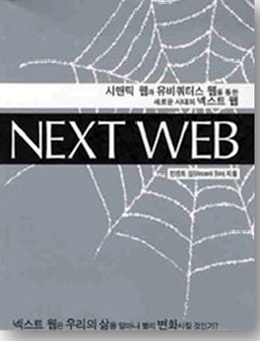
Author of "NEXT WEB"
Bachelor's degree, Alphacrucis College, New Zealand
Former Education Team Lead at SAS SOFTWARE, the US statistics and IT company
30+ years of hands-on and leadership experience across IT, ERP, ESG, AI and digital platforms
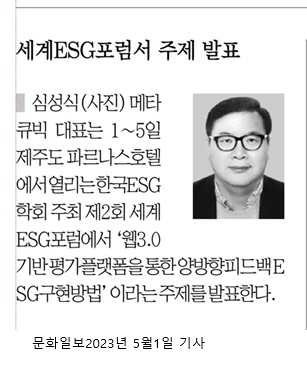
Keynote speaker at the World ESG Forum; featured in Munhwa Ilbo and other media
Drawing on real project experience in generative AI, semantic AI and personal platform development,
he trains you to be "not just someone who uses AI, but someone who applies it to life, business and ministry."
You finish one real deliverable every week. In 4 weeks, your own revenue-ready AI platform is complete.
Prompt engineering & building your own AI partner for the AI era
Create brand content by combining text, image, voice and video AI
Design and optimize your own homepage + local search engine
Design a revenue model with your local community and small businesses
Auto-generate short-form videos + complete your local-search-linked SNS auto-promotion system
Finalize your local revenue engine
Join in person in Auckland or online via Zoom — wherever you are.
Start date: Saturday, 22 August 2026, 2:30 PM to 5:30 PM (NZ time) / 11:30 AM to 2:30 PM (Korea time)
Same time every Saturday (Aug 22, Aug 29, Sep 5, Sep 12)
Venue: St Columba church (480 Ti Rakau Dr, Botany Downs, Auckland) — in person, bring your laptop / online via Zoom also available
Tuition: $80 for the full 4 weeks / KRW 70,000 (Korea) — group discounts available
Enquiries: +64 9 441 3311 | toow21@gmail.com
New Zealand participants: sign up and pay on the All in Auckland website, https://allinauckland.com/
Korean participants: sign up and pay on the All in Seoul website, https://allinseoul.net/
New Zealand participants: at https://allinauckland.com/member/form, click the 'Sign Up' button at the top right, then enter your ID, password, email, name, gender and phone number.
Korean participants: at https://allinseoul.net/member/form, click the 'Sign Up' button at the top right, then enter your ID, password, email, name, gender and phone number.
Fill in your organisation (company/church) and role (position/ministry title), generate your thumbnail QR code, agree to the terms and submit. You will receive a confirmation link by email (check your spam folder too).
After payment, email your transfer receipt to toow21@gmail.com and you will receive your Zoom link.
New Zealand: log in at https://allinauckland.com/member/login, click the icon at the top left, then select the "Payment History" menu.
Click "Add" at the bottom right, enter [your ID + registration fee] in the payment description, enter $80 as the amount, then click the PAYPAL button.
Korea: log in at https://allinseoul.net/member/login, click the icon at the top left, then select the "Payment History" menu.
Click "Add" at the bottom right, enter [your ID + registration fee] in the payment description, enter $80 as the amount, then click the PAYPAL button.
No PayPal account? You can still pay by card with just your email. Once payment is confirmed, your Zoom link will be emailed to you.
Enquiries: +64 9 441 3311 | toow21@gmail.com
Application-first AI education, built on 30 years of real-world delivery.
Real consulting and development experience in ERP, POS, logistics and distribution systems
AI, big data and cloud taught from a real-world problem-solving perspective
Lectures that show you "what you can do with AI" — not just "what AI is"
Teaching that connects technology + education + faith + life
Youth and young-adult ministry experience across New Zealand and international churches
Developed and taught a digital Bible education platform for young people
AI and digital literacy training for churches, mission organisations, seminaries, schools and the general public
From generative AI to semantic AI, all the way to personal, group and local platforms
Not just ChatGPT usage training — meaning-based AI (semantic AI) and a scalable digital platform structure
A structural understanding of how AI use expands from the individual to the group, the church and the region
Real application, not theory
From young adults to business owners
Complete a revenue-ready platform built on your local community
A revenue-ready AI homepage, built together with your local community and small businesses.
Build it yourself now, rank high in local search, and turn automated SNS into local income.
$80 for the full 4 weeks (KRW 70,000 in Korea) · Group discounts available · Zoom option included
..


Connect an AI YouTube search engine, LocalCubic, a church website and useful local content so the church can become a digital doorway for service, discovery and real relationships.

A local resident does not first need another church advertisement. They often need a trustworthy door to useful information, help and relationships close to home.
A church sits among families, migrants, young people, older residents, small businesses, schools, clinics, welfare services and community groups. People may live nearby and still have no idea what the church contributes to local life.
This page therefore frames the church less like a billboard and more like a helpful local desk: a place that listens, points people toward good resources, tells local stories and creates pathways into genuine community.
LocalCubic can be used as a local digital layer that helps people discover useful information around where they actually live. A church can become one trusted node within that larger community picture.
Organise worship, care, volunteering, education, youth and newcomer information in a clear local context.
Connect dining, health, schools, welfare, events and other information residents actually search for.
Turn local people, places and events into useful YouTube content that can be searched again later.
Move beyond views toward enquiries, registrations, visits, volunteering and real community participation.

Keep the essentials such as worship times, sermons and directions, then add practical local information so the site helps a resident understand both the church and the community around it.

Useful local information and key places in one simple guide.
Church and community events, seminars and programmes.
Restaurants, cafes, shops and services worth discovering.
Services and agencies that can assist people who need help.
Schools, courses, seminars and next-generation programmes.
Clinics, healthcare information and community health events.
Practical opportunities for the church and residents to serve together.
Searchable stories about people, places and events.
Sermons, worship, testimonies, mission reports, events and teaching can become hard to find once they accumulate. An AI-assisted search structure organises videos around topics, audiences, questions and local needs.

The church site builds trust, LocalCubic supports local discovery, and the AI YouTube search page supports content discovery. They have different jobs but should feel like one journey to the visitor.
The trusted home for worship, care, volunteering, local guides, newcomer information and next-generation ministry.
See the digital doorwayA local entrance for food, health, education, events, welfare, churches and community services.
View the city networkOrganise video by topic, audience, question and location so the right sermon, event, class or local story can be found quickly.
Explore the search-engine courseOne way to serve locally is to give attention to people, organisations and small businesses doing good work. Content should not exploit the community for promotion; it should document and strengthen the community with care.

Frame the work like a studio case study: show the problem, the design decision and the behaviour you want to test. The goal is not more promotional material but more useful local touchpoints.
A church may have substantial content, but it is hard to discover when it does not match the questions local people are asking.
Start with local needs and connect church, community and video content around those questions.
Do not promise rankings. Observe local searches, enquiries, event participation, service connections and real visits.
Beginning 22 August 2026, the 7th cohort moves beyond AI basics and connects content, a website, a YouTube search page and local distribution into one practical system.
AI persona, prompt foundations, a ministry-aware AI partner, local information collection and content planning.
Use writing, images, voice and video for church communication, local introductions and community event content.
Build a searchable YouTube page, AI search structure, church homepage and connected LocalCubic media hub.
Connect short-form video, YouTube, social media, the website and LocalCubic into a repeatable distribution path.


Do not start by building a huge platform. Start with one neighbourhood, one question and one audience, then repeat a simple pattern of useful content, search and connection.
Connect healthcare, dining, education, events and welfare information in a resident-friendly format.
Make seminars, worship events, children's programmes and classes easier to discover.
Create respectful stories about good local businesses and services that residents can find.
Connect the purpose, participation details and real stories of local service projects through video and search.
Provide useful youth and children's content through AI, video, search and a clear website experience.
Help people settle into a new area with both church information and practical local guidance.
SmartCubic's public City Network connects multiple city and local portals. The same principle can help churches serve their own neighbourhood faithfully while learning from useful local models across other cities.
Local churches keep their own identity and local focus while useful information can connect across a wider city network.


The core units used in this model.
If you are unsure whether to begin with a church website, LocalCubic information, an AI YouTube search page or local content, tell us where you are now and what you want to build.
Connect LocalCubic for local discovery, AI for searchable information, YouTube for local stories and the church website for real relationships. Build the practical structure with us over four weeks.